

핵심 답변
An implant is not a treatment that ends once it is placed. Even among people who received implants around the same time, the condition differs widely some years later, and a considerable part of that difference comes from care…

An implant is not a treatment that ends once it is placed. Even among people who received implants around the same time, the condition differs widely some years later, and a considerable part of that difference comes from care habits. This article summarizes what is always explained to patients who have had implant treatment near Yaksu Station, Seoul: the care habits that help an implant last, the habits to avoid, and what is checked at regular checkups.
To start with the conclusion, the core of implant care is preventing peri-implantitis. When the gum around an implant becomes inflamed and the bone begins to dissolve, the implant can no longer be supported, yet because there are no nerves around an implant, pain is felt late even when a problem develops. It is not that things are fine because nothing hurts; the structure is one that has to be cared for before it hurts. That is why two things, daily hygiene and regular checks, determine how long an implant lasts.
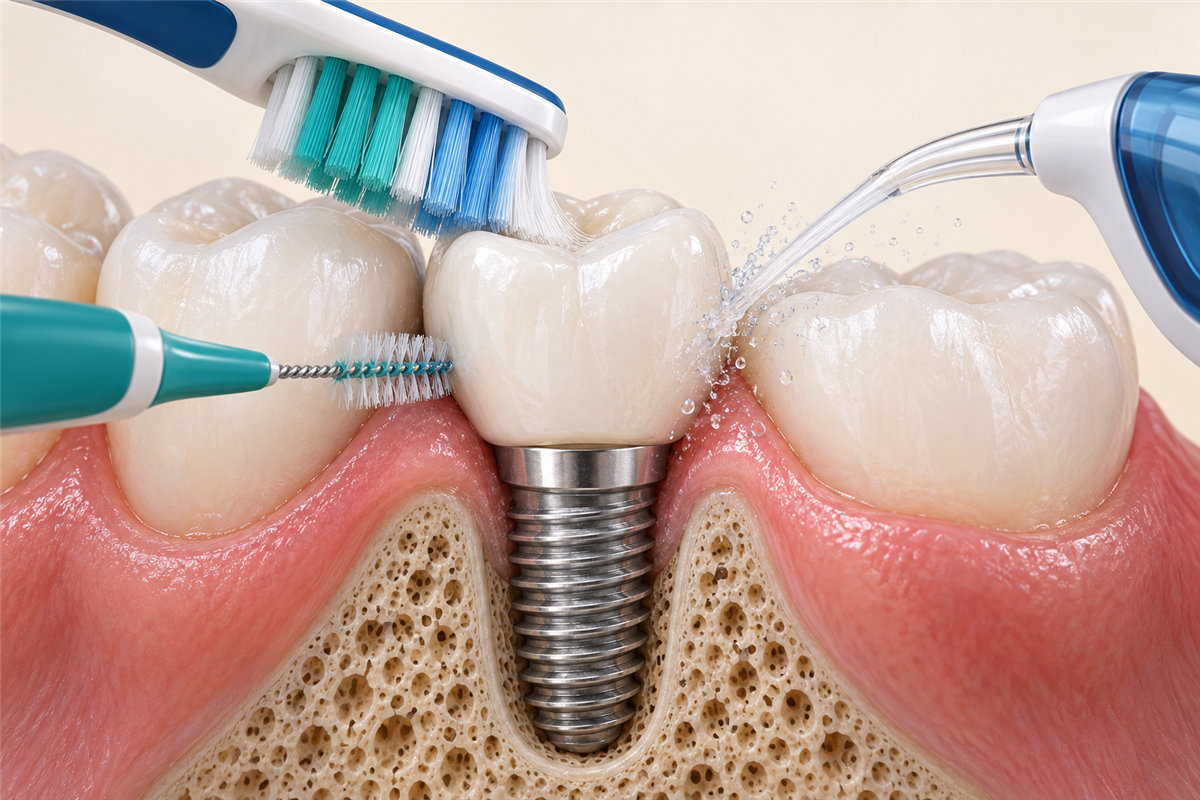
Habits shared by people whose implants last
- Brushing the margin: Peri-implantitis begins as plaque builds up at the margin where the implant meets the gum. Place the bristles at an angle against the gum margin and brush gently.
- Using an interdental brush: The area around an implant can become a structure where food gets caught more easily than around natural teeth. In a number of areas an interdental brush is more useful than floss, and it is better to have the dental clinic show you the size that fits.
- A water flosser (oral irrigator) as a supplementary tool: Its water pressure helps remove large food debris, but attached plaque is removed only by brushing and an interdental brush. It is important not to replace these with a water flosser alone.
Habits that damage an implant
- Smoking: It is a leading factor that reduces blood flow in the gums and raises the risk of peri-implantitis. If you want your implant to last, quitting smoking is the most effective investment.
- Excessively hard or sticky foods: Repeatedly chewing ice, hard nut shells, dried squid and the like on the implant side can cause the prosthesis to break or the screw to loosen.
- Teeth grinding and clenching: If you grind your teeth during sleep, strong force is applied to the implant repeatedly. If this applies to you, please consult about whether to wear an appliance.
- Skipping checkups: Putting off regular checkups because there is no discomfort is the most common path to failure.
What is checked at a regular checkup?
A regular checkup is not a simple look; it is a process of catching problems early.
- Checking the gum condition around the implant and any plaque or tartar buildup
- When needed, checking changes in jawbone height with X-ray imaging
- Checking the prosthesis for movement, the state of the screw, and changes in the bite (occlusion)
- Professional cleaning around the implant (tartar removal, air polishing and so on)
The checkup interval differs with your oral condition, but in general, regular checks every few months are recommended. If you have a history of gum disease or are smoking, a shorter interval may be needed.
If you notice these signs, do not wait for your checkup date
- The gum around the implant bleeds or swells
- Food has suddenly started getting caught frequently in a particular spot
- The implant or the prosthesis feels as if it is moving
- Bad breath gets worse or you notice a taste of pus
A feeling of movement in particular may be a problem with the prosthesis or with the implant itself, so it needs to be checked quickly.
The criteria for telling the causes apart are explained in detail in a separate column, “My Implant Feels Loose: How Do a Loose Screw and Inflammation Differ?”
https://allcaredc.kr/column/implant-mobility-causes
What to do when a problem has progressed because care was neglected is covered in “Implant Revision Surgery: When Is It Needed and What Should Be Checked?”, and sensitivity in a natural tooth rather than around an implant is covered in “Tooth Sensitivity: Why Teeth Are Sensitive Without a Cavity and the Criteria for Treatment”.
In closing
The lifespan of an implant is made by the precision of the procedure together with the care that follows. Daily brushing of the margin and use of an interdental brush, reducing risky habits, and regular checks. These three are enough, and conversely, if these three are skipped, even a good implant will have difficulty lasting. If it has been a long time since your implant was last checked, or if you would like to know how to care for it, please visit Allcare Dental Clinic near Exit 5 of Yaksu Station (02-2232-2911) to have your implant checked and receive guidance on how to care for it.
자주 묻는 질문
Implants do not get cavities, so why do they need care?
If I use a water flosser, can I skip the interdental brush?
How often should I come for regular checkups?
Can I have an implant placed at another dental clinic checked here?
I sometimes feel discomfort when chewing. Can I wait until my checkup?
365올케어치과는 약수역 치과를 찾는 약수동·신당동 주민분들께 진료 상담 일정과 진료시간을 안내합니다.

※ 본 칼럼은 일반적인 정보 제공을 위한 것으로 개인의 진단·치료를 대신하지 않으며, 치료 결과는 개인의 상태에 따라 차이가 있을 수 있습니다. 최종 검토일: 2026. 10. 22.


