

핵심 답변
If your implant feels slightly loose or lifted while you are eating, the first worry is usually "Has something gone wrong?" In this article, I explain the possible causes of a loose implant and the criteria for telling apart…

If your implant feels slightly loose or lifted while you are eating, the first worry is usually "Has something gone wrong?" In this article, I explain the possible causes of a loose implant and the criteria for telling apart cases that can be resolved relatively simply from cases that need prompt treatment.
To start with the conclusion, implant looseness can be divided into two broad types. One is a problem with the restoration on top (the crown) or the connecting screw, and the other is a problem where the implant root itself moves within the jawbone. The first type can in many cases be resolved by tightening the screw or adjusting the restoration, but the second type may mean that inflammation around the implant or bone loss has progressed, so it needs to be checked quickly. It is difficult to tell which one it is from how it feels alone; an accurate judgment is only possible through examination and imaging. If you feel looseness, please do not put off having it checked, even if the symptoms are mild.
When the problem is the crown or screw on top
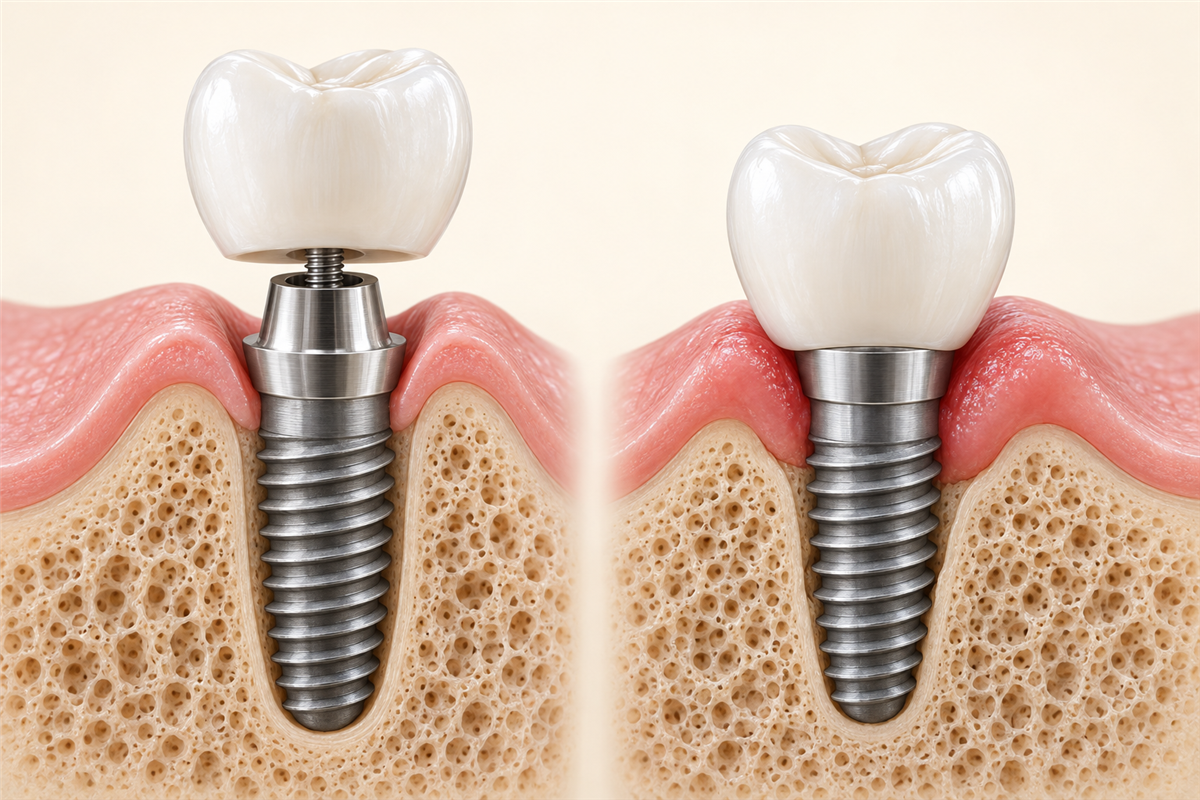
An implant consists of a body placed in the jawbone (the fixture), a middle connecting part (the abutment), and a crown that sits on top. The screw that holds this structure together can loosen over long use because of chewing forces.
- In many cases, only the crown moves slightly, with no clear pain or gum swelling.
- Re-tightening the screw or replacing worn parts can be considered as a solution.
- However, if you keep using it while it is loose, the screw can break or the restoration can crack, so even if it seems simple, it is better to have it checked soon.
When the implant itself is loose
If the implant body is moving within the bone, the situation is different. A typical cause is peri-implantitis. Bacterial inflammation develops in the gum around the implant, and as it progresses, the jawbone holding the implant breaks down and its support weakens.
- In many cases, the gums swell or bleed, with discomfort when brushing.
- There may also be pus or worsening bad breath.
- Depending on how much bone loss has occurred, the implant may be kept with inflammation treatment, or removing the implant and re-treatment may need to be considered.
Peri-implantitis can sometimes be harder to notice on your own than gum disease around natural teeth. This is because there are no nerves around an implant, so pain may appear late. That is why having no pain does not mean everything is fine.
Clues for telling the two apart
An accurate distinction requires examination, but the following clues can serve as a reference.
- What moves: If only the crown feels like it is rattling, a crown or screw problem is possible; if it feels like it moves from the root, a problem with the implant itself can be considered.
- Gum condition: If there is swelling, bleeding or pus, inflammation becomes more likely.
- How it developed: If it suddenly started to feel loose one day, it may be a screw problem; if discomfort has grown gradually, progressing inflammation can be suspected.
However, these are only reference clues, and in practice both problems can be present together. The treatment direction can only be decided after checking both the bone and the screw with X-ray imaging.
Why you should not keep using a loose implant
If you keep using a loose implant as it is, the problem can grow. A loose screw becomes difficult to remove if it breaks, and the longer inflammation is left alone, the more bone loss progresses and the fewer treatment options remain. A problem that could be resolved with a relatively simple step if checked early can, over time, turn into a situation where revision surgery has to be considered.
In these cases, have it checked promptly
- The looseness gets clearly worse over a few days
- The gums swell and there is pus, or they bleed frequently
- Chewing hurts, so you avoid that area when eating
- You notice a smell or an unpleasant taste from the implant area
If even one of these applies, prompt care comes before looking up general information. Please contact the dental clinic you have been visiting, or a nearby dental clinic, as soon as possible.
If the examination shows a problem with the implant itself and revision surgery needs to be considered, I have summarized the decision criteria in a separate column, "Implant Revision Surgery: When Is It Needed and What Should Be Checked?", so please refer to it as well.
Closing thoughts
Depending on the cause, a loose implant may be resolved with a simple step, or it may need inflammation treatment or re-treatment. The key is not to delay, and to find the cause as soon as you notice the looseness. If your implant feels loose or lifted, please visit Allcare Dental Clinic near Exit 5 of Yaksu Station, Seoul, to check its current condition and the steps needed, including an X-ray examination. I will explain clearly what is happening and what options you have.
Written and reviewed by Dr. Kwon Jongjin, Honorary Director — Specialist in Oral and Maxillofacial Surgery, PhD in Dentistry
자주 묻는 질문
My implant feels loose but it does not hurt. Can I just wait and see?
Will tightening the screw fix it right away?
If I have peri-implantitis, does the implant have to come out?
Can you treat an implant that was placed at another dental clinic?
중구 약수·신당동 일대에서 약수역 치과를 찾는 분들께 365올케어치과의 의료진과 진료 과목, 주차 안내를 한곳에 정리해 두었습니다.

※ 본 칼럼은 일반적인 정보 제공을 위한 것으로 개인의 진단·치료를 대신하지 않으며, 치료 결과는 개인의 상태에 따라 차이가 있을 수 있습니다. 최종 검토일: 2026. 10. 30.


