

핵심 답변
When patients hear that an implant needs to be placed again, the first worry is often not the cost or time, but "Did I not take good care of it?" This article summarises the typical situations in which implant revision surgery…

When patients hear that an implant needs to be placed again, the first worry is often not the cost or time, but "Did I not take good care of it?" This article summarises the typical situations in which implant revision surgery is considered, and what should be checked first before deciding on it.
In short, cases that need revision can broadly be divided into problems with the upper structure, such as the screw or prosthesis, and problems where the implant root (fixture) itself did not properly bond with the jawbone, or bone was lost due to peri-implantitis. The former can often be resolved by remaking the prosthesis or replacing the screw, but the latter may require removing the implant, restoring the bone, and then placing a new implant. It is difficult to tell which is the case from the outside, and an accurate judgement requires checking the bone with X-ray and CT scans.
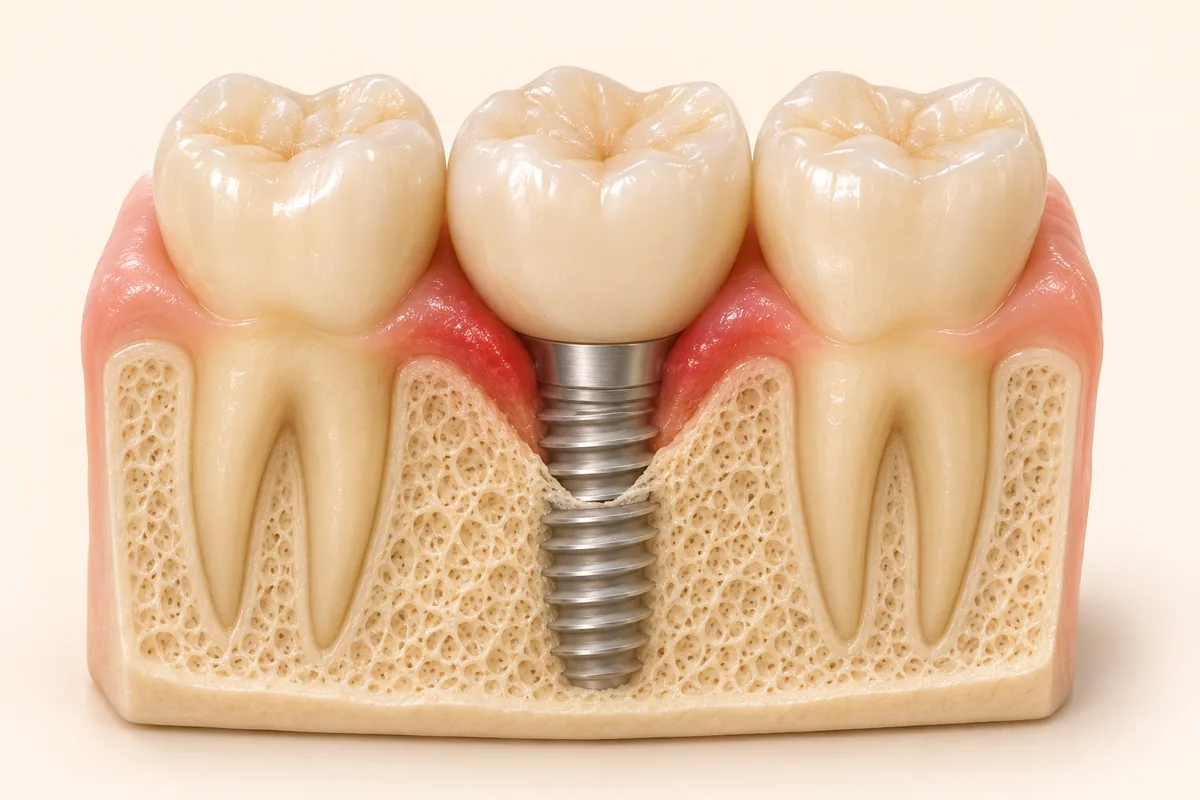
Typical cases in which revision surgery is considered
Implants can be used for a long time depending on how they are cared for, but in the following situations, the need for revision surgery is reviewed.
- Failed osseointegration: when the implant did not properly bond with the bone early after placement, and looseness or pain continues
- Progressing peri-implantitis: when inflammation was left untreated and much of the surrounding jawbone has been lost
- Repeated screw or prosthesis breakage: when the same problem keeps coming back even after repeated tightening and replacement
- Position or angle problems: when the implant was placed in an unsuitable direction, so chewing force is concentrated on one side and pain and breakage keep recurring
What to check before revision surgery
Checking the following items together before deciding on revision can help reduce unnecessary procedures.
- Bone condition: X-ray and CT scans are used to check the amount and density of the remaining bone.
- Extent of inflammation: check for signs of inflammation such as gum swelling, bleeding or pus.
- General health: factors such as diabetes or taking osteoporosis medication can affect healing speed and the timing of revision surgery.
- Information on the existing implant: it helps with treatment if you know the clinic where the implant was placed and the implant manufacturer and size.
Can a new implant be placed right after removal?
The timing of re-placement depends on the bone condition. If inflammation and bone loss are not extensive, placing a new implant right after removal can be considered. However, when much of the bone has been lost, a bone graft is often done first, and the new implant is placed after waiting a certain period for the bone to become stable. The waiting period depends on the grafting area and how well healing progresses, so it is best to ask for an expected timeline after your examination.
What are the disadvantages of putting off revision surgery?
If inflammation or looseness is left as it is, jawbone loss progresses, so the bone graft area later becomes larger and treatment takes longer. A problem that could have been resolved early on by replacing the prosthesis or treating the inflammation may, over time, reach a point where removal and re-placement are needed.
In these cases, please have it checked promptly
- When the implant area becomes noticeably loose within a few days
- When the gums swell and pus or blood keeps coming out
- When chewing is painful, so you avoid that area while eating
- When the prosthesis or screw repeatedly becomes loose or breaks
If even one of these applies, seeing a dentist takes priority over looking up general information. Please contact the dental clinic you have been visiting, or a nearby dental clinic, quickly.
In closing
Depending on the cause, implant revision may end with remaking the prosthesis, or it may require inflammation treatment, or a bone graft and a recovery period. The key is to have the cause checked when you first feel discomfort, rather than putting it off. If your implant feels loose or pain keeps returning, it is advisable to visit Allcare Dental Clinic near Exit 5 of Yaksu Station, Seoul, to check its current condition and what needs to be done, including an X-ray examination. The situation and the available options will be explained clearly.
Written and reviewed by Dr. Kwon Minsoo, Representative Director — Specialist in Oral and Maxillofacial Surgery and in Advanced General Dentistry
Consultations in English: Dr. Kwon Minsoo can see you in English.
자주 묻는 질문
Does implant revision surgery always require a bone graft?
How long does revision treatment take?
Can revision surgery be done on an implant placed at another dental clinic?
Once an implant is removed, can a new one be placed?
약수역 치과를 찾으신다면 3·6호선 약수역 5번 출구에서 걸어서 1분 거리인 365올케어치과의 위치를 먼저 확인해 보세요.
※ 본 칼럼은 일반적인 정보 제공을 위한 것으로 개인의 진단·치료를 대신하지 않으며, 치료 결과는 개인의 상태에 따라 차이가 있을 수 있습니다. 최종 검토일: 2026. 11. 19.


