

핵심 답변
Many people lose a back tooth and simply carry on because it does not cause much trouble right away. Near Yaksu Station, Seoul, including Heungin-dong and Sindang-dong, it is not uncommon for patients to visit only after leaving…

Many people lose a back tooth and simply carry on because it does not cause much trouble right away. Near Yaksu Station, Seoul, including Heungin-dong and Sindang-dong, it is not uncommon for patients to visit only after leaving the gap empty for several years. This article explains what changes when the gap is left as it is, and what criteria are used to choose among the three options: an implant, a bridge or a denture.
To give the conclusion first, which of the three to choose is not a matter of preference but is decided by four conditions: the number and position of the missing teeth, the condition of the neighbouring teeth, the amount of jawbone, and your general health. If one tooth is missing and the neighbouring teeth are healthy, an implant is considered first, as it does not require reducing the neighbouring teeth. If the neighbouring teeth already have large restorations or surgery is a burden, a bridge can be a reasonable choice, and if several teeth in a row are missing or the jawbone and general health are not favourable, a denture can be the safer choice.
What changes if the gap is left empty?
- The opposing tooth moves down: A tooth that has lost its partner gradually moves toward the empty space. Over a long time, there may not be enough height left to place a restoration later.
- The neighbouring teeth tilt: As they lean into the empty space, food gets trapped between the teeth, making decay and gum disease more likely.
- Chewing force shifts to one side: This can lead to wear and sensitivity in the teeth on the other side, and discomfort in the jaw joint.
- The jawbone shrinks: Bone in a spot that no longer receives chewing stimulation is resorbed. If you want an implant later, an additional bone graft may become necessary.
The options after the bone has shrunk are covered in a separate column, "Is an implant possible when there is not enough bone?"
https://allcaredc.kr/column/bone-graft-implant
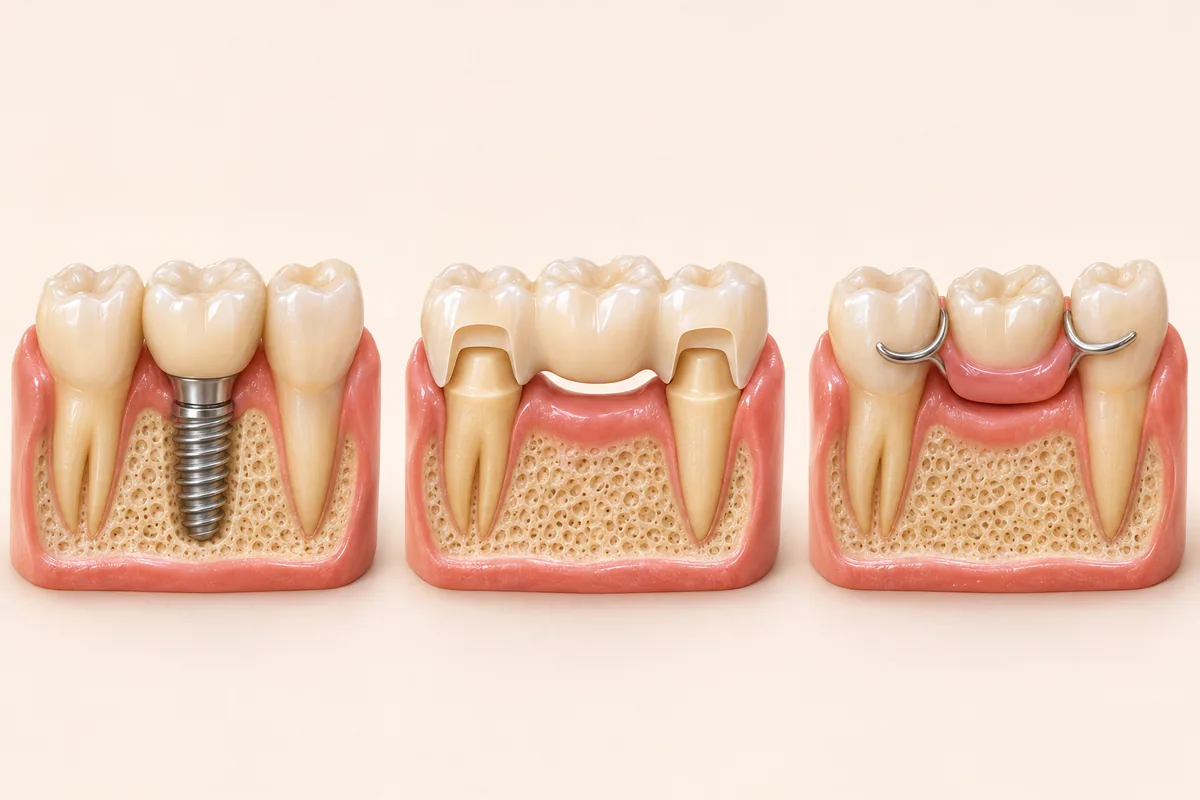
Implant: a method that leaves the neighbouring teeth untouched
An artificial root is placed in the jawbone at the gap, and a restoration is attached on top. Because it stands on its own, it does not share force with the neighbouring teeth.
- The neighbouring teeth are not reduced. Being able to keep healthy teeth as they are is the main advantage.
- Force is transmitted directly to the jawbone. Chewing stimulation reaches the bone, which helps slow resorption.
- The jawbone must be checked. If the amount or density is insufficient, a bone graft may be needed as well, adding time for the bone to settle.
- General health is reviewed too. Timing and method are adjusted depending on factors such as diabetes or osteoporosis medication.
Bridge: a method that uses the neighbouring teeth as supports
The teeth on either side of the gap are reduced to serve as supports, and a restoration of three connected units is fitted over them. Because it can be done without surgery, treatment time tends to be short.
- Treatment time is short. There is no need to wait for bone to settle, so chewing function is restored relatively quickly.
- The neighbouring teeth must be reduced. If those teeth already need crowns, little is lost, but healthy teeth lose that much of their structure.
- Cleaning underneath is difficult. Because the three units are joined, regular floss cannot pass through, so cleaning tools designed for bridges must be used.
- More force falls on the supporting teeth. The roots and gums of those teeth need to be in good condition for the bridge to last.
Denture: when several teeth are missing or surgery is difficult
There are partial dentures, which hook onto the remaining teeth, and complete dentures, used when almost no teeth remain. They can be made without surgery and can address several missing teeth at once.
- The surgical burden is low. They can be made even when surgery is difficult because of general health or jawbone conditions.
- They are removable. They must be taken out and cleaned every day, and a period of adjustment is needed when you first start wearing them.
- Chewing force is relatively weak. Chewing efficiency is lower than with natural teeth or implants.
- They can be combined with implants. Placing a few implants to hold the denture in place can greatly reduce movement.
None of the three is the right answer in every case. The answer that fits each person differs depending on how much of the remaining teeth can be preserved and whether the jawbone can provide support.
Four conditions that decide the choice
- Number and position of missing teeth: The possible methods differ depending on whether one tooth or several in a row are missing, and whether the gap has no support behind it, as with the last back tooth.
- Condition of the neighbouring teeth: If they are healthy, an option that does not reduce them is considered; if they already have large restorations, using them as supports is considered.
- Amount and density of the jawbone: This is checked with 3D CT. If it is insufficient, treatment is combined with a bone graft or another method is considered.
- General health and treatment period: The medications you take, any uncontrolled systemic conditions and the number of visits you can manage are all taken into account.
What to check in a consultation
- How many options are possible in my situation, and the reason for each
- If I choose a bridge, which teeth need to be reduced and by how much
- If I choose an implant, whether a bone graft is needed and how long the whole process takes
- Whether the opposing tooth has already moved down, and whether orthodontics or adjustment is needed first
- How to care for the chosen option afterwards and how often to have check-ups
- The overall schedule, the number of visits and how the costs are broken down
If you choose an implant, care standards for making it last are covered in a separate column, "Implant aftercare: habits and check-up standards for long use."
https://allcaredc.kr/column/implant-aftercare
Closing thoughts
The gap left by one missing tooth is not a problem limited to that one spot. Because the opposing tooth, the neighbouring teeth and even the jawbone change along with it, when you decide matters more for the range of options than what you fill it with. If you have left a gap empty for a long time or find it hard to judge which method suits you, it is advisable to first have your remaining bone and neighbouring teeth checked with a 3D CT diagnosis at Allcare Dental Clinic near Exit 5 of Yaksu Station (02-2232-2911).
Written and reviewed by Dr. Kwon Jongjin, Honorary Director — Specialist in Oral and Maxillofacial Surgery, PhD in Dentistry
자주 묻는 질문
Is it really a problem to be missing just one back tooth?
Which lasts longer, an implant or a bridge?
If I have a bridge, can I switch to an implant later?
Can I get an implant if I have diabetes?
If several teeth are missing, do they all need implants?
중구 약수·신당동 일대에서 약수역 치과를 찾는 분들께 365올케어치과의 의료진과 진료 과목, 주차 안내를 한곳에 정리해 두었습니다.

※ 본 칼럼은 일반적인 정보 제공을 위한 것으로 개인의 진단·치료를 대신하지 않으며, 치료 결과는 개인의 상태에 따라 차이가 있을 수 있습니다. 최종 검토일: 2026. 11. 16.


